Brand and Brand Identity – working definitions

Ever been in a conversation whare you though you were discussing the same thing, only to realize that you’re actually thinking about different things? I often get that sense when I’m discussing brand and brand identity with clients. For myself, I have very simple definitions for both that help me to think clearly about what I’m doing.

Brand = Reputation

Your brand is your reputation in the hearts and minds of your audience: customers, employees – everyone who interacts with your business. When we look at brand this way, we realize that everything we do impacts our brand. Defining your desired reputation and aligning your business activities toward building that reputation is often called branding or brand building.

Brand Identity = Visual Representation

Human beings are visual creatures – of the 5 senses we rely primarily on our sight for perceiving the world, forming opinions and making decisions. Brand identity is such an important aspect building brands, that it is often confused with the brand itself.

Brand Identity is the visual representation of a company’s desired reputation. Translating what your company provides, represents, and values in a way that is quickly and accurately perceived by your target audience is what effective brand identity is all about.

Simple, huh?

These are my working definitions that help me to quickly get to the essence of the work I do. Brand specialists have thoroughly analyzed the dynamics of branding and if you need a more thorough explanation, just google ‘brand’ and read on.
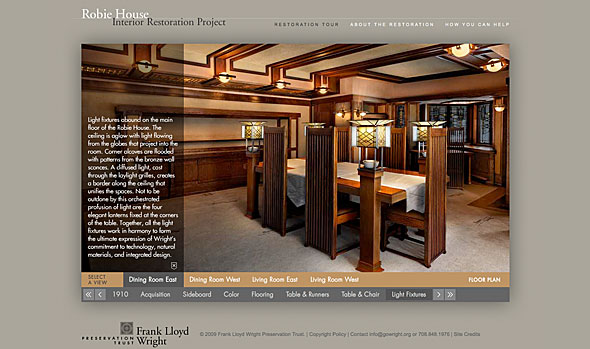
 

The Robie House Interior Restoration Project Web Site

robie-case1

The Robie House Interior Restoration Project web site received the 2010 Webby for cultural institutions

Situation:
Architectural historians consider Frank Lloyd Wright’s Robie House one of the most important buildings in the history of American architecture. The building is being restored to its original splendor by the Frank Lloyd Wright Preservation Trust. The Preservation Trust wanted to create a web site that would meet the following objectives: 1) Build awareness of the Restoration Project 2) Immerse visitors in Wrights’ original vision for the Robie House interior and 3) Inspire people to make donations to the project.

Solution:
Zünpartners, a brand strategy and communications design firm, brought James Eaton Design onto the project team to collaborate on the site design strategy, interface design and web development. To accomplish the Preservation Trust’s goals, we designed an immersive tour of the Robie House that enables visitors to view the living room, dining room and the objects within.
To fully convey Wright’s vision, a ‘virtual restoration’ was performed on one of the rooms. This was done by photographing the room from the same camera angle and lighting conditions as the original historical photo, then digitally recreating the room’s original furniture and lighting. Visitors can see the process of restoration on the room from it’s condition upon acquisition to a final view showing the fully restored room in the evening. Wright’s lighting design for the room is something no one has seen for nearly 100 years.

Results
The site has been extremely well-received by the media and the preservation community. In 2010 the site won the Webby award for cultural institutions. The Webby Awards is the leading international award honoring excellence on the Internet, including websites, interactive advertising, online film and video, and mobile websites.

Site Credits
Bill Ferdinand, zünpartners, in partnership with James Eaton, James Eaton Design
Flash Development: David Bedingfield
Digital Imaging: Robert Frolich, Filtre Studio
Photography: James Caulfield, James Caulfield Photography
Art Direction: Bill Ferdinand, zünpartners